
Odyssey 10.230-73
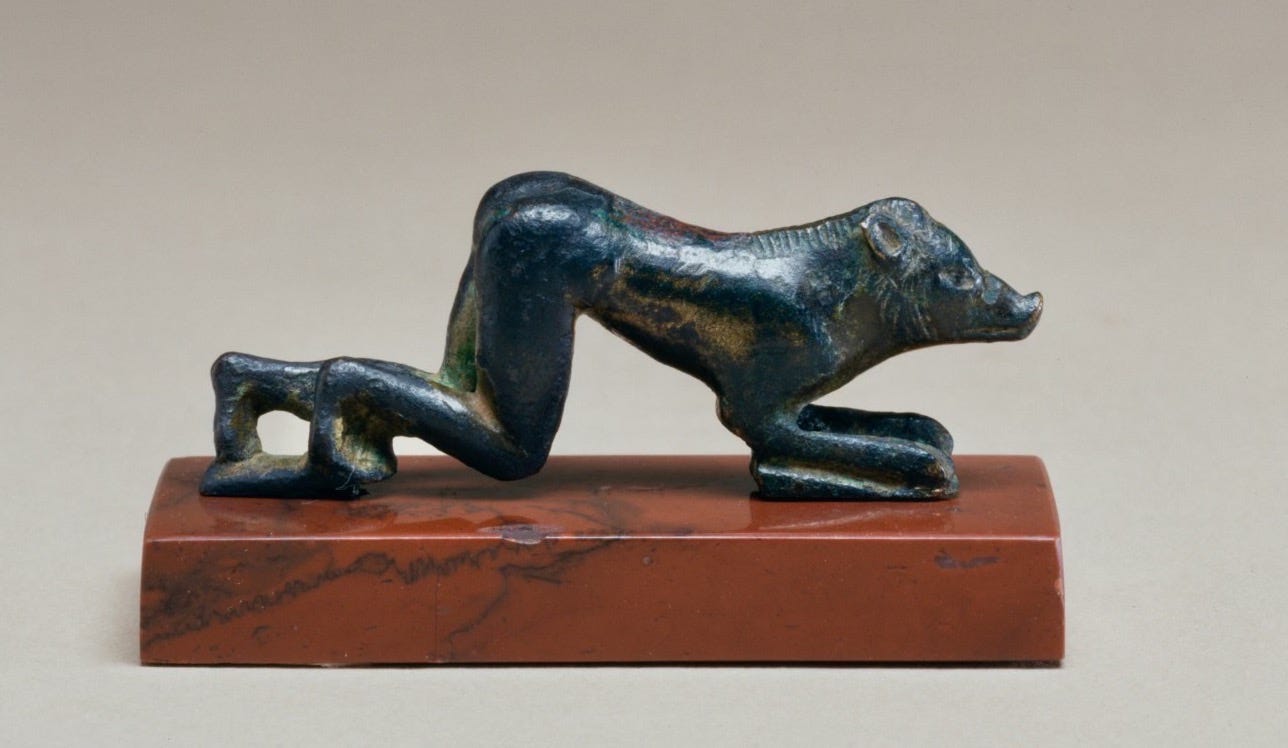
Out she came fast and opened the shining doors
And started inviting them: and all together, they followed in their stupidity.
Eurylochus stayed back—he suspected there was a trick.
She led them in and seated them on couches and chairs,
Put in cheese for them and barley groats and green honey
And stirred them into a pottage with Pramneian wine: she mixed into the muesli
Baneful drugs, so that they might altogether forget the land of their fathers
But once she gave it and they drank it off, right after
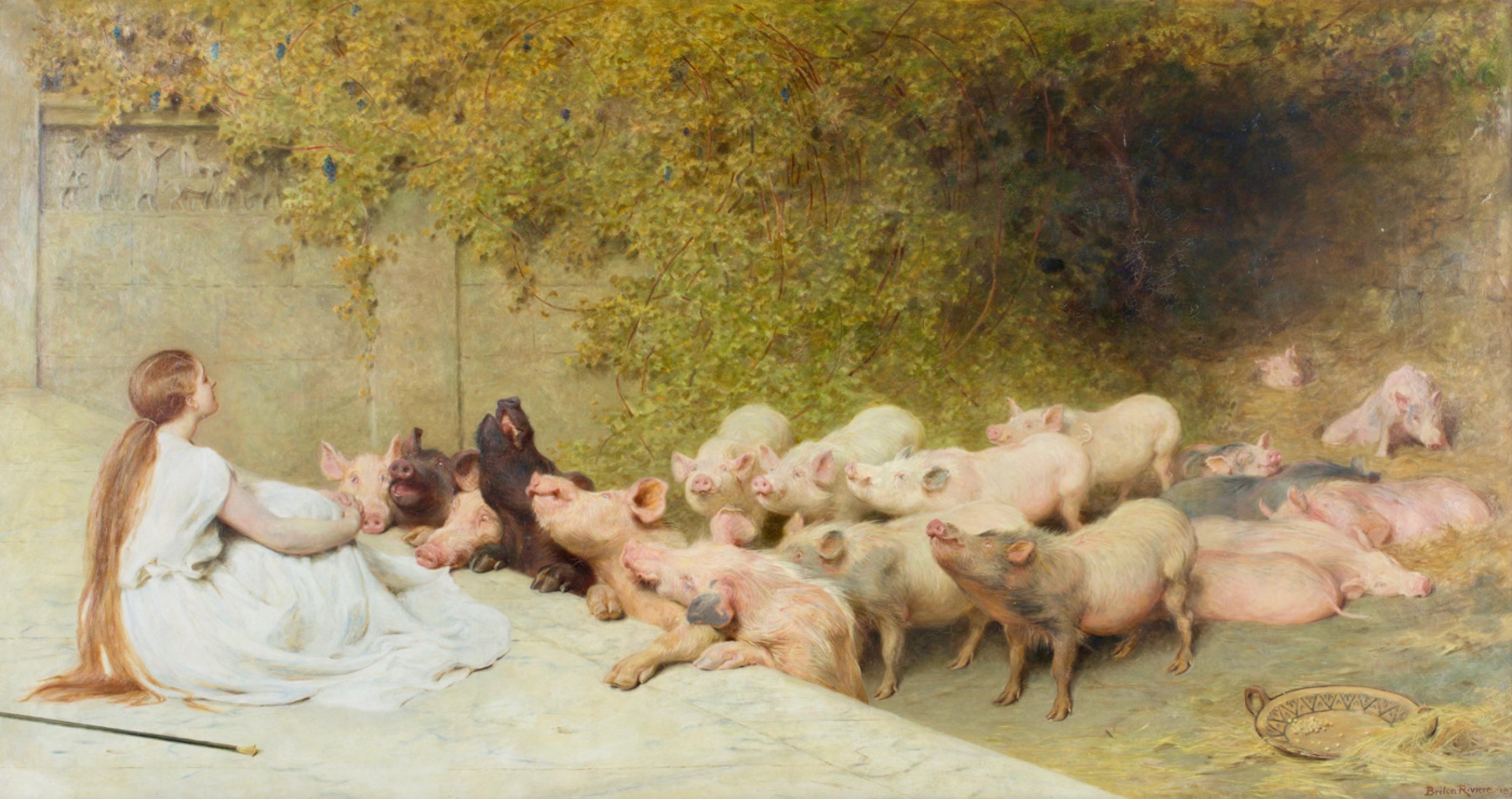
She struck with her wand, and confined them in the pig sties.
And they began to have pigs’ heads—and pigs’ voices and hair,
And build! Yet the mind within stayed steady—the way things were before, in fact.
So they’re wailing there, all penned up, while for those men Circe
Threw two kinds of acorn by, and cornel cherries
To feed on—the sort of thing ground-wallowing swine are always eating. (Od. 10.230-42)
Circe is invisible in this scene. Why do I say this? She’s clearly before us, doing all sorts of striking things. But the medium of Homer’s narrative is, first of all, a musical one, as well as a visual one (through the performer) and a lingual one, in the familiar literate sense that words are conveyors of ‘information’ which allow us to put together a story in our intellects and imaginations. Hence the resources available to Homer in, for example, creating a foreground, where he brings elements to the front of consciousness while suppressing others, are likely to be unique in relation to literary techniques. It is the treatment of Homer only in that final sense, the sense in which we register and assess novels and other literature, which has led to a great deal of abuse, and misuse, of Homer’s poetry in academic circles. When we assess the music, and the show, only through the close reading of its libretto, we are bound to find fault with it as a) quaintly and folksily repetitive, b) limited in its vocabulary, and c) puzzlingly roundabout, among any number of other misapprehensions and ways of missing the point. As they say about concerts and other live events, ‘you had to be there.’ An editor would send Homer’s copy back to have it purged of all its repetition and unhelpful frou-frou, with an angrily scribbled note to ‘tighten it up and get to the point!’ Imagine what he’d do with the lyrics of a Disney song or a Bach cantata. Homer is not performing a novel. Over the course of a brief passage, not even fifty lines, we shall be able to explore a surprising number of Homer’s musical resources.
Singularly and peculiarly lost in the translation, from live performance to scribbled libretto, is the role and gestalt of the numerous noun-and-epithet phrases Homer has nevertheless made famous. Their usage is not necessarily familiar to us through our experience of song. They seem instead to be children of the marriage of music and dramatic narrative Homer has developed. ‘Swift-Foot Achilles’ and ‘Poly-Wily Odysseus’ are typical. The adjectives in these phrases are not so much predicates as ‘epithets’; that is, πόδας ὠκύς and πολύμητις register not so much as assertions about Achilles and Odysseus, but as extensions, elucidations, of their names. The distinction ‘epithet’ applies in Homer to adjectives that usually register as part of the subject rather than the predicate. In some instances they function almost as titles, like ‘your majesty’. It is as though when Homer wants to evoke these characters, to put them in the foreground of his stage, he sings them out with their full titles. Most often this happens when he summons them there in the line before they deliver a speech. It seems to be a way that the performer himself ‘steps into’ the role, both announcing and simultaneously doing it, immediately before he gives a speech in the character’s first person as ‘Lord of Men’ Agamemnon or ‘Poly-Wily’ Odysseus.
The last example illustrates that the adjective does not altogether lose its semantic power in its use as an epithet. Many is the time that we are prompted to suspect the wiliness of what follows, precisely by the announcement of Odysseus as speaker in this form. It happens at the very beginning of the Tale of the Wanderings, seemingly to keep us on our guard throughout his story! (See 9.1) The Odyssey poet’s alertness to the semantic fluidity of adjectives inside these phrases seems indicated by his use of ‘blameless Aegisthus’ immediately prior to the opening speech of Zeus (1.29), where the father of gods and men precisely blames Aegisthus for what happens him, rather than fate or the gods. Paolo Vivante cites a number of instances in Homer where, when an epithet is used outside of its customary noun-and-epithet phrase, this time separated from its intended subject as an adjective in the predicate, it can in fact acquire a sense which contrasts, even, with its apparent sense inside that phrase.1 I comment,
It is as though the lexical signification of these epithets is thrown into peculiarly sharp relief when they are removed from their more aural and evocative role within the [dancing] phrase. To stretch a point, one might even say that the epithet and the adjective are different words.2
The instance of ‘blameless Aegisthus’ is striking, however, in that ‘blameless’ (ἀμύμων) is here very much an epithet, not a predicate adjective. Its deployment immediately before Zeus’s accusing speech seems therefore overtly provocative.
It is astounding that the oralist ideologue’s take on this phrase is that there is nothing to see (or hear) here: we are told that ‘blameless’ does not register as a predicate in its role inside a purely metrical phrase, which is supposed to do no more than refer to Aegisthus, while also filling up a segment of an hexameter line by adding three syllables to the three already in his name. But even those of us who register an obvious contextual irony in Homer’s use of the phrase, or perhaps even a difference between Homer’s assessment of Aegisthus and Zeus’s, need also to recognise the more elemental musical effect of the name-plus-epithet rhythm: Homer thereby summons Aegisthus to the forefront of our consciousness, before Zeus goes on to complain about him in his speech. It is only when Zeus has made his point about the man, affixing blame, that Homer’s prior evocation resurfaces as a dissonant resonance in the musical memory. The sequence bespeaks design. This does not mean it is good design: those who feel the cognitive dissonance too strongly, ought to have the courage to criticise Homer’s choices here, rather than join those who explain them away through the reflexes and semantic handicaps of a purely metrical theory of composition. They then make up a tradition based on this theory, as though it were some sort of primitive achievement to ‘fill up’ a line of hexameter verse, and call this tradition ‘oral’, although it completely ignores Homer’s inbuilt pitch accents and phrasal melodies. Modern ‘Homeric Studies’ explains away the libretto, after first ignoring all of Homer’s melody.
The evocative epithet occurs also in descriptive passages, not only in respect of people but objects as well. Vivante wrote the groundbreaking studies on the subject of the Homeric epithet, especially their poetic effect and registration, albeit without reference to the music of such designedly evocative, melodic naming. Ignoring the pitch accents does not, however, prevent Vivante from distinguishing poetic rhythm from its underlying metre. Although such a distinction would seem to be elemental to the nature of poetry—that poetic rhythm arises not from repetitive metre but from the way in which accented words selectively reinforce or syncopate that underlying metre—it is a distinction which seems largely to be lost on the majority of Homer’s commentators. Here is Vivante:
Take, in Il. 3.423, Helen joining Paris in his chamber: ἡ δ’ εἰς ὑψόροφον θάλαμον κίε δῖα γυναικῶν [and she, to the high-roofed chamber, she went, the divine among women]. We have a simple act of going, but notice how it is expressed. From the initial ‘she’ to the final noun, Helen’s presence spreads through the verse, quickened by the nimble verb [κίε] near the center. The effect is one of lightness and solemnity at once. The epithets give fullness to the moment by simply touching off what is there. We linger upon steadfast shapes even while the passing act removes them from our view. Transience finds solidity, and solidity is in turn dissolved. We have rest in movement and movement in rest—at once, tranquility and motion. A translation such as ‘Helen, divine among women, went to the high-roofed chamber’ would only give us embellished description. The force of Homer’s verse lies in its rhythm—in the way the words take position, in the way each pause hints suspense, and in the way the parts integrate to realize a growing presence. It would be inadequate merely to point out a combination and adaptation of metrical formulas: the verse has an intrinsic unity, and it came on one wave of rhythm.3
The descriptive phrase ‘radiant among women’ (δῖα γυναικῶν) seems in this case equally predicate and fulfilling epithet, separated as it is from its subject ‘she’ (the monosyllable ἡ) at the beginning of the line. One needs to remember, when one is obliged to ingest this poetry as words on a page, that this is a separation not in space but in time: the phrase at the end knits the line into both a rhythmic and semantic whole, reaching back past an anapaestic run through the ‘high-roofed chamber’ (ὑψόροφον θάλαμον) to irradiate its solitary subject ‘she’, back at the beginning of the line. ‘Helen’s presence spreads through the verse.’
Now what does all this have to with Circe and her invisibility? It turns out that Homer is strangely coy about how he introduces her and presents her. When viewing and hearing the performer in front of you, Circe becomes obviously seen, in one way, and yet unseen, unfocussed—almost as if she’s behind you. It’s said she calls to Eurylochus and his men, but Homer (Odysseus) gives her no speech. She is merely a ‘she’ (ἡ, 230), with no further depiction or evocation beyond her several actions. Her presence does not so much spread through the verse, like Helen’s, but haunts it like a ghost. We only hear her name, at last, eleven lines later—lonely at the end of a line with no epithet or title! She had in fact been invoked earlier with a flurry of epithets and adjectives, when the men first reach her threshold:
They took their stand in front of the door of the goddess, Pretty-Braids,
And they began to hear Circe within, singing with a beautiful voice
As she went back and forth at the loom—a big one, ambrosial—a web for goddesses,
Finely woven and tasteful, and bright, as their works tend to be. (220-3)
ἔσταν δ’ εἰνὶ θύρηισι θεᾶς καλλιπλοκάμοιο, 220
Κίρκης δ’ ἔνδον ἄκουον ἀϝειδούσης ὀπὶ καλῆι,
ἱστὸν ἐποιχομένης μέγαν ἄμβροτον, οἷα θεάων
λεπτά τε καὶ χαρίεντα καὶ ἀγλαὰ ϝἔργα πέλονται.
Note, however, that though Circe, goddess of beautiful braids, is summoned to the front of the imagination’s stage by name, epithets, adjectives, and sounds, and her web and loom even more so, she is all the same invisible to the men at this point: heard not seen. Keats says, about the images on a Grecian urn, that ‘Heard melodies are sweet, but those unheard/Are sweeter …’ In the Greek of the line,
Κίρκης δ’ ἔνδον ἄκουον ἀϝειδούσης ὀπὶ καλῆι,
And they began to hear Circe within, singing with a beautiful voice,
we almost hear her directly through the liquid, pitch-accented long vowels. Is a goddess heard, but not seen, even more beautiful?
When Circe actually appears, however, out the door, she’s just a ‘she’. It’s the doors themselves that are ‘shining’! The focussing power of Homeric versifying keeps her in our periphery, but illuminates the opening of her doors. You’d expect the revelation of the goddess to be the focus of the poet’s gaze—not the doors. Eurylochus suspects a trick and stays back, so we have no eyewitness to what goes on next within. Perhaps we are to suspect that Odysseus must have become intimate with Circe to find out—perhaps we have expected that intimacy all along. Eurylochus, for now, stays outside, but Odysseus the initiate must have already passed through those doors.
The lines that follow describe the wholesome cheese, barley, honey, and wine, with which Circe makes a porridge for her guests. There is not even a personal pronoun; verbs in the third person serve to supply a subject. The key ingredients, however, are ‘baneful drugs’ (φάρμακα λυγρά), which would cause the men to ‘forget the land of their fathers.’ Hence Circe’s recipe could induce an effect similar to that of the lotus flower. The description is conditional, however; it expresses an intent rather than an actual result. I say this because it is evident after their transformation, that the men are wailing in sorrow. It seems not unreasonable to suppose that their despair may stem from the drugs not quite working, and that they are in straits most of all about never reaching home.
But is it not possible that their wailing is existential, and would have been triggered even if they weren’t homesick? The reason for despair may come purely from their transformation. The next stage of Circe’s enchantment of the men, after their ingesting her pottage, is initiated by a strike of her wand. It is not clear whether she is meant to strike each of the twenty-one, or if she strikes the air over them somehow; the performer needs to decide what to do with his staff. Immediately she confines them in her pig sties, which are apparently a part of her interior design. Only then do they start to turn into pigs.
Is the sequence important? Or is it fanciful to think that merely confining men in sties is halfway to turning them into pigs? The confinement and separation from society’s table seem to be significant. These actions indeed underlie society’s rationale for imprisonment, whether as a social or individual good, or a political punishment. (Rehabilitation seems an option beyond the pale for mortals, in Circe’s eyes. All go to the sties.) Their change in diet is marked, just as it was between immortal and mortal diners at Calypso’s table: while the men enjoy barley and honeyed Pramnian wine at their last supper, in the sties they get acorns. Just as delicious intoxicating ingestables can make you forget who you are and where you’re from, perhaps imprisonment can, by itself, turn human into animal.
Separation and confinement both seem to be a feature of animal husbandry, as practiced by the Cyclops, for example. He separates the rams and billies from the ewes and nannies, then puts the lambs and kids to the teat. The sorting and the counting express his control—his dominion, shall we say—over the animals, but in Polyphemus’ case also allow him to express his care for them. Sorting and numbering his flocks seem to be essential reflexes of an overseer in the Odyssey, whether that is Proteus and his seals, Penelope and her geese, or the Sun himself over the cattle of the year’s days.
But there is an unexpected twist to the story of the men’s confinement and transformation, which appears to transcend the physical aspects of growing pig hair and being imprisoned in a sty. The sting in the tail is also an unexpected musical climax, which must be lost on those who disregard Homer’s pitch accents.
And they began to have pigs’ heads—and pigs’ voices and hair,
And build! Yet the mind within stayed steady—the way things were before in fact. (239-40)
οἳ δὲ συῶν μὲν ἔχον κεφαλὰς φωνήν τε τρίχας τε
καὶ δέμας, αὐτὰρ νοῦς ἦν ἔμπεδος, ὡς τὸ πάρος περ.
Note the three emphatic syllables in a row, νοῦς ἦν ἔμπεδος. They are three straight, long, accented syllables, two circumflexes (rising and falling in pitch within each long vowel sound), acute (rising pitch on a sonant closed syllable). The basic underlying rhythm of the dactylic hexameter is long-short-short, a long downbeat with two shorts in the upbeat. Hence three straight long and emphatic syllables must be rare and marked occurrences in the course of dactylic poetry, and indeed any poetry, whose rhythms generally propagate through alternating stressed and unstressed syllables. In paying attention to the pitch accents in Homer’s text, we are at last able to confirm what must seem intuitively obvious to the punters, that musical stresses needs best correspond to semantic ones. You cannot play the opening of Beethoven’s Fifth or the Ride of the Valkyries to scenes of toddlers playing with blocks. (For a fuller discussion of the new ‘law of tonal prominence’ for ancient Greek, please see my most recent paper here.)
‘Yet the mind within stayed steady.’ If this means what it seems to mean, never have more portentous words gone ignored by the sorts of people who write about the ‘history’ of philosophy. I have drawn the notion of ‘within’ from the constituents of ἔμπεδος, literally ‘in the ground’ and hence ‘firm-set’ or ‘steadfast’. But the context seems to justify my rendering. Externally, the men are becoming pigs, in their heads, voice, hair, and bodily frame; but their mind was steadfast. This principally means that it did not change, unlike everything else about them; but the implication is also that the effect of Circe’s wand was on everything external and sensible about the men, not what was otherwise. It must be said, however, that there is, as well, a change in what the pig-men take inside themselves from outside; that is, their food.
We take it that the men are still the men they were, though trapped inside pigs’ bodies and natures. Behind Blue Eyes is a song by the Who which suggests that their condition applies to anyone born with an human face, too. Even one with pretty blue eyes, which, by the way, I’ve known a pig to have. Perhaps lonely and misunderstood Polyphemus sings a song called Behind Blue Eye. “No one knows what it’s like …”
The shock of the rhythmic emphasis suggests that there is something shocking also, or terrifying, about the men’s minds persisting through the metamorphosis into swine. What does Homer feel is the impact? Is this like a poet or a physicist or a revered grandmother being forced to do slave labour in a field? Or is it like a foreigner unable to communicate her medical emergency? Or is the terror rather something we feel, in the case that their mind persists in its faculty, but the men do not actually know that they are pigs eating acorns? Like stockbrokers and Amazon shoppers?
We are used to the mind-body distinction since DesCartes. But DesCartes’s insight in the cogito is really more radical than that. The thinking being who doubts is separate from everything else it perceives, not only sounds and visions, textures, tastes, and smells, but dreams. One might also include what we refer to as unconscious or subconscious processes in that list. Of all the representations of our condition made since, DesCartes’s seems closest to Homer’s in these lines.
One best tells what a speaker means by a word, however, when one has in mind what words he considers to stand in opposition to the one he uses. A mind-body distinction does not hold in those terms for Homer. In point of fact, it is difficult to imagine how one might translate the notion ‘body’ into Homer’s Greek, when applied to human beings, except in the sense ‘corpse’ (σῶμα, νεκρός). Homer’s conceptions are generally concrete; even νοῦς, ‘mind’, is usually ‘intention’, ‘thought’. But in this instance he does seem to be pointing to the mind as a being or faculty. Homer’s concreteness bears out in a number of distinctions which witness a plurality in our condition, not a duality. Aside from the mind (νοῦς), there are also the usually plural φρένες (which I render ‘mind’s vessels’, taking a hint from the lungs). Then there’s the θυμός, the ‘hot, living breath’, which appears to be the main seat of consciousness. Odysseus is famous for speaking to his θυμός, chiding it to ‘bear up’ under duress. When Hector revives on the battlefield, his θυμός is said to be regathered (Il.XV.240). The ‘mind’ is not this ‘life’s breath’, but it appears to be related, like a harnessing sail to the wind. There are also the always plural πραπίδες—the lungs again? Or the ribs? The diaphragm? And of course there’s the heart, which we still conceptualise, uniquely perhaps, in the Homeric way. Perhaps special mention should be given to the eyes in Homer, as not mere conduits for vision, but special witnesses in their own right. That is, not just me, but my ‘own eyes saw it.’ All of these, and more, can be seen in Homer as what we call ‘seats of consciousness’.
Each of them would seem to suffer from the Cartesian paradox, when we try to identify a seat of consciousness with the self—that is, the entity to whom we refer in the first person or with a proper name. What is that thing which ‘I’ points at? The ‘Odysseus’ who speaks to his θυμός? The Cartesian account of vision encapsulates the paradox: an image is focused on the retina by a lens. That image is translated somehow into electrical data which transmit to the brain. Well and good. Who is watching the screen? Is there a little man with beady eyes and spectacles, behind blue eyes? This paradox puts paid to the modern fetish for identifying the mind with the brain. ‘Brainy’ actually means fatty and dumb. Homer seems to have little regard for the brain. Greek for ‘brain’ means contents of the head (ἐγκέφαλος). Homer seems more to look to the breath and the lungs. Words are winged because they move through air. They are air, in a material sense. The best we can do, with the whole of our apparatus, is give special shape, direction, and density to the air as we expel it from our lungs.
In the ancient world there developed a potent opposition between soul and body, ψυχή and σῶμα. The mind or the reason is argued to be the highest part of the soul, in the works of Plato and of Aristotle. This is the duality later supplanted by DesCartes’s, of mind and body, or mind and everything else. But the fundamental classical opposition does not register in Homer. It is true that for all the Greek thinkers, a main difference between a living being and a corpse is the absence of the soul in the latter. But ψυχή should not be translated ‘soul’, or even ‘psyche’, in Homer. It is a thing which flies off at the moment of death, gibbering like a bat, headed to a dank and dreary place. It is not our true or highest self. It still answers to the name it was used to hearing in life, but if you speak to her, she doesn’t have any news. I think ‘ghost’ gets at the idea. It survives death, but it would seem that nothing very important survives death in Homer, except one’s reputation. Although the Homeric psyche only leaves a human being at the moment of death, it doesn’t seem to contribute anything to the animation of life, like the ‘life’s breath’ and the ‘heart’ do, when one is yet living.
In light of Homer’s way of speaking and representing things, it can seem to an Homerist that the later vaunted philosophical oppositions, such as ‘soul/body’ and ‘mind/body’, are simplistic, naive, and brutally reductive. In addressing the varieties of our empirical experience and its seats, as we also do when we speak ‘from the heart’ or ‘from the gut’, Homer seems better to answer the realities of our lived experience in the nouns and verbs of his poetry; and, in my opinion at least, this is to be the better philosopher.
“There are more things in heaven and earth, Horatio,
Than are dreamt of in your philosophy.” —Hamlet
Eurylochus runs away in terror back to the ship after whatever it is he’s seen. Between his blubbering and his hysteria, he provokes and irritates everyone. But when he finally gets around to telling his tale, he stokes the oral-theory folks to life. This is because Homer (Odysseus) nearly repeats a series of lines, in Eurylochus’ mouth, which he had already used in direct description. This has to be explained, they say. It’s a singer’s rest! Such repetitions are a concession to the imagined burdens of an improviser composing from metrical formulas during a performance. But as soon as one learns his text enough to realise that Homer is arranging his words with a view to their tonal and rhythmic effects through an underlying hexameter, not pasting together hexameters from toneless metrical formulas, one realises that Homer’s narrative is at once, and natively, a musical composition. And one would as soon explain repetition in music, as wetness in water.
The rest during musical repetition is really in the auditor, if it exists anywhere, but when nearly equivalent lines are sounded, one is jarred awake at the slightest changes between the two. For one thing, this version of the lines is heard in a different voice. There is actually created an hyper-focus on the dissonances. Rather than the extraordinary sequence about men becoming pigs, and the musical climax on the persistence of the mind in the transformed men, we get simply this:
“And they vanished at the same time as a group, nor did a one of them
Emerge into light: and I sat a long time on the lookout.” (259-60)
What amazed Eurylochus, what terrified him to his core, is that the men disappeared! They were made invisible. By going into the house and not re-emerging, they vanished. He has no idea at all that they have been turned into pigs, or anything else, nor anything about what it is they have gone through, though their minds were preserved. There is clearly an hierarchy of initiates here. Eurylochus did not go in the door. He has no idea what went on within the god’s house. And yet he has escaped still to tell a tale of fear and amazement, and so to make a desperate plea, when Odysseus asks him to guide him to Circe’s abode, that he leave him there and himself steer clear of the threat—whatever it was made the men vanish.
But Odysseus will brave an approach.
“Eurylochus, right you are, you stay here in this plot,
Eating and drinking by the ship, empty and black.
But me? I’m going; for a force comes upon me, of necessity.” (271-3)
The subject, ‘necessity’ (ἀναγκή) is separated from its preceding adjective ‘strong’ (κρατερή). I infer that there is a predication going on. In my translation I try to preserve the impact of the words in the order that they appear, although inflected languages generally allow a lot more freedom in word order than is possible in English syntax. But Homer’s is a musical composition: hence nothing is free in the placement: every word and its effective intonation is placed exactly where it needs to be, not from ‘metrical necessity’ or ‘grammatical rule’—though these also have to be observed—but from musical precision, stoking desire in counter-rhythms and cadencing in consummation. To the extent that we are looking at musical compositions in inflected languages, teachers of classical languages need to realise that word order in Greek and Latin is perhaps even more important than in English, albeit for reasons unrelated to syntax.
So what is the necessity which manifests for Odysseus here? What is it that takes away his choice, as though he were at the dominant 7th chord in prospect of the tonic? He has certainly been a coward in sending forth his men like lab rats. Perhaps he needs to atone. Let’s call that a moral necessity. He also needs to rescue his men, whatever it is that’s happened them. Let’s call that a practical necessity, but also a moral one and an human one. But is there also a musical necessity? Odysseus is the man who learns the towns and the mind of men. I reckon he’s the man who needs to know. This is a very powerful necessity. Circe is a mystery, so far an invisibility. If he had to infiltrate the Cyclops’ cave—
So as I might see the man! And what if he gave me a guest gift? (9.229)
—then surely he must penetrate Circe’s mystery, her interior sanctum, go further than Eurylochus or the likes of his horny mate Polites. If Odysseus does not go to her, cross the threshold to know Circe, the song would be lost.
In Greek:
Paolo Vivante, The Epithets in Homer: A Study in Poetic Values, New Haven: Yale University Press, 1982, 105-6.
A. P. David, The Dance of the Muses: Choral Theory and Ancient Greek Poetics, Oxford: Oxford University Press, 2006, 145.
Vivante, Homeric Rhythm: A Philosophical Study, Westport, Conn.: Greenwood Press, 1997, 4.