
The Haunted Text
2. Identity

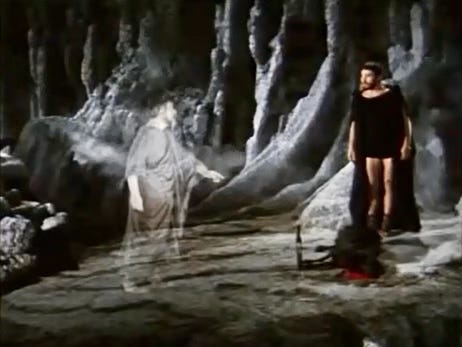
Teiresias comes on the stage announced as a Theban. In the next breath, he embodies as a man holding a golden sceptre (Od.11.90-1). What can one make of these two sparse features of the mimetic creature now approaching us, on the one hand a Theban, on the other a man with a gold sceptre?
Let us note that Teiresias makes his first ever appearance in Greek letters here in Homer. He must already be well-known, however; he gets, and therefore we infer that he needs, no introduction. Hence our position is awkward. We ourselves do not know him from Adam, except via later sources. (Of course stories that are later written, or otherwise documented, are not necessarily later in origin.) All my instinct is to focus on the man with the sceptre: here again is the doughty rhapsode, stepping forward with his stick in this, his latest guise. One ought not to have to read the book to experience the drama unfolding before one’s eyes. Here comes a seer or prophet; that stick is actually a golden sceptre (so my mind has been prompted by the performer to think) which says that he is authorised to speak with authority. What more do I need to know? And yet, the narrator (an epic voiceover) has announced him as ‘Theban’. So, annoyingly, we are presented an unknown. What is Thebes to Homer, or she to Thebes?
I say ‘annoyingly’ because efforts at intertextuality, or virtual intertextuality (like the movement called ‘neoanalysis’)1 invariably lead us down a rabbit hole, quite away from the dramatic moment at hand. It can sometimes seem that such studies, even if they are themselves absorbing and ingenious, nevertheless lead us away, rather than towards, the text at the heart of the comparison or the allusion. This can be frustrating when the Homeric composition itself cannot simply be taken as read, in that it continues to yield new puzzles and new insights to new readers without any resort to esoterica. Classicists may not accept the comparison, but the modern approaches seem to be saying little more than ‘this’ is ‘that’, in the fashion of the oldest critical tack known in the reception of Homer, the modus of allegory. Those early allegorists, however, may well have been responding genuinely to their predicament, that they could no longer make sense of who or what Homer’s gods were, for example, in relation to their customary worshipful practices, or how to make sense of these gods’ actions in a story. The moderns, by contrast, seem no longer interested in such glaring questions, which perennially confront a youthful initiate; they instead seem to find freedom as well as a sense of context in alternate or parallel stories, akin to the modern penchant, inspired by spurious ‘science’, for possible universes and alternative timelines. In the spell of the eye-widening moment where one says, ‘hey, this is really that in a new skin,’ Homer’s poem (or Odysseus’ tale) becomes just a version of something.
It seems likely that the biases which accompany oral theory in its genes, help make plausible the idea that one can usefully find comparisons, or even claim sources for a poem, in material where no poem has been remembered at all except for the barest templates for a story. We are dealing only with ‘traditional’, ‘orally transmitted’ material, after all, where the Homeric poems are supposed to represent a moment’s instantiation of something non-literate, and presumed to be fluid. In literary contexts, one does best to demonstrate the fact of an allusion, often aided by theories of dating, but most persuasively in the way that an allusion, if taken, enriches the interpretation of the text in hand. In oral theory, on the other hand, allusion to tradition is thought to be endemic, including in the idea that alternate routes for the storyteller, paths not actually taken, are all nevertheless ambient in the moment of telling, contributing to its unique gestalt. The modern Homerist seems suspended ecstatic in the moment between the this and all the possible thats. Under the circumstances, the significance of the particular form and meaning of Homer’s poem, especially the sense that it takes pains to establish by internal context, cannot help but be diminished. One almost seems liberated from the actual poems of Homer.
The ‘this’ that is the composed music of either of Homer’s poems, however, is altogether more than a matter of narrative choice. I have demonstrated that Homer’s Odyssey is a musical composition which designedly exploits the accentual features of Greek to produce memorably significant patterns of rhythm and melody.2 Such things needs must be composed in advance of performance, as if scored or scripted. Moreover, the Odyssey quotes Homer’s Iliad as another individual musical composition, not word for word but accentual pattern for accentual pattern, to pointed allusive (and perhaps parodic) effect. These are, for us, new discoveries which demand a renewed interest among students of Homer, who have been mining far afield, in the fine detail and broad movements of Homer’s poems as musical scores intended for dramatic enactment and performance by a soloist. There is plenty of inspiration and diversion to be had in Shakespeare’s sources, but for God’s sake, the play’s the thing. An Étude by Chopin is not best thought of as a version of what might have been, but rather heard (and played), with skill and discernment, for exactly what it is.
And yet Thebes, along with other loci which resonate with their native stories, is made distinctly ambient in Homer’s telling of the Odyssey. Hence refusing to speculate is not a possible path of prudence. Consider Ino, for example, whom we met in Book 5. She was the daughter of Cadmus, the founder of Thebes. She is the sister of Semele, who, by one account, was impregnated in Zeus’s deadly thunderbolt and bore the god Dionysus as her son. The mother’s death left the baby in dire need of care; the nurses of Dionysus play a big role in his stories. Ino may well have been head nurse or the original Maenad. Now, Dionysus gets no explicit mention in the Odyssey, but the further we go down this rabbit hole, the more you might think that the Odyssey is actually about Dionysus, or that Odysseus himself functions at times as this god’s avatar.
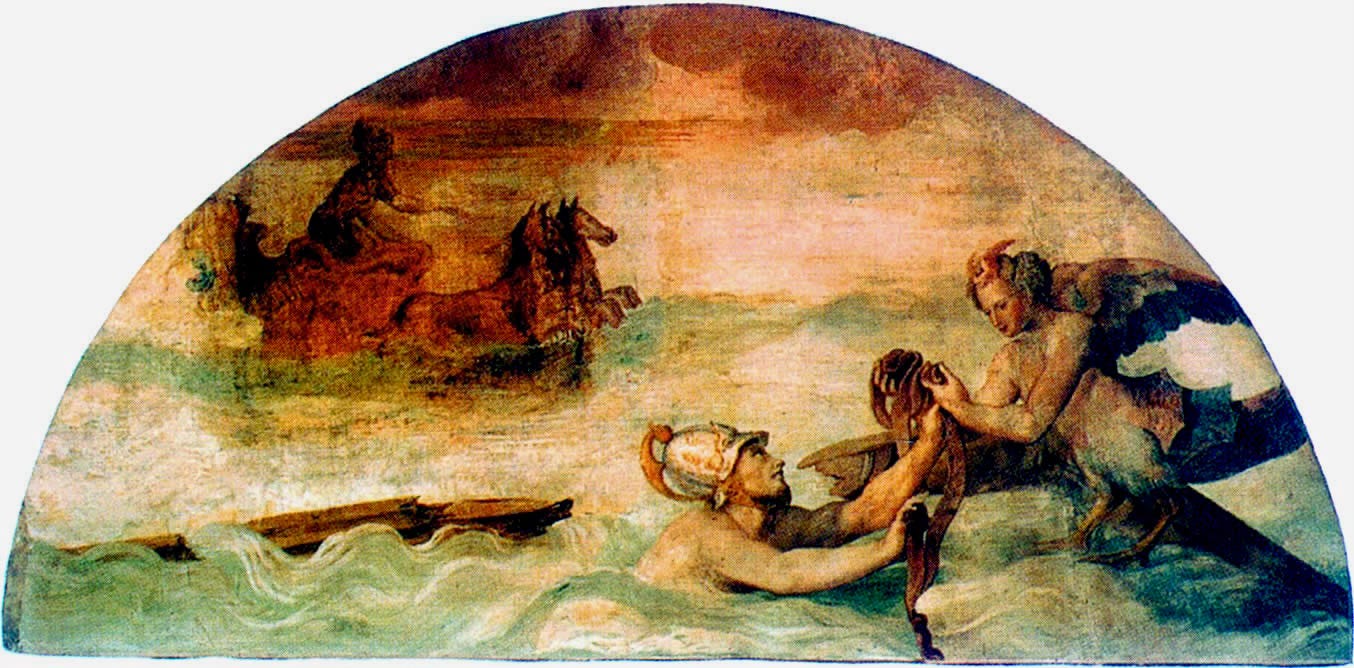
Ino appears to Odysseus as a sea bird. She offers the shipwrecked man, riding a keel’s timber, her potent veil to tie beneath his sternum, which would then protect him from harm. He must strip off the clothes Calypso had given him and dive into the sea, naked except for the veil; so Ino instructs. It seems in doing so she is having Odysseus perform rites reminiscent of those from Eleusis, where an immersion in the sea precedes the rites of Demeter and Dionysus, and also rites from Samothrace, where the initiates tie a purple sash around them prior to diving in the sea. These latter rites were thought to save the initiate from storms at sea.3 Now ‘reminiscence’ is a deceptive notion; we have no idea about the historical relation between Homer’s poems and the sketchy knowledge we get, mostly from third parties tattling secrets, about the practices of ancient Greek mystery cults. Our ignorance of Homer’s time and place is an absolute and non-negotiable fact of our predicament, in relation to the problem of Homeric allusion. We recall Herodotus’ statement that all that the historical Hellenes knew about the gods came from Homer and Hesiod:
It is they who created for the Greeks their theogony; it is they who gave to the gods the special names for their descent from their ancestors and divided among them their honours, their arts, and their shapes. (Herodotus History 2.53, tr. Grene)
This could easily be read to apply to the rituals by which historical Greeks came to honour the gods: that in some instances the Homeric descriptions came first, in the way that acts and lines from the Gospels came to play a part in the mass. I do not at all dismiss this idea, or this quote from Herodotus, like most professionals; but my reservation has only to do with the nagging intuition from my own reading, that Homer seems to be parodying or otherwise having his way with these rituals, and many other things besides. There is a missing world of songs and chthonic rites and polar stars in which Homer plays, whose membranous connection to the ancient one—his future—has allowed only the passing of some small granules beside the giant pyramids of his poetry. Yet Homer’s comedy does not preclude his most sincere investment in what these rituals intend, as we shall see. I think of the various priests in Shakespeare’s comedies. Even in Midsummer Night’s Dream or the Roman plays or pagan Lear, the tenets and foils of Christianity and Christian ritual bear silent witness.
The detail in Ino’s instruction that once Odysseus has made dry land, he must turn his back upon returning the veil to the sea, is the surest sign that Homer is tapping into some form of recognisable rite. We also see, in Hades, that Odysseus must turn his back on the ovine sacrifice and face the oncoming ghosts. The danger of turning around to see what’s going on is a staple of stories from Lot to Orpheus. ‘Mystery’ is as much about what must not be seen, as what the initiate (mystēs) must be made aware of; the family of words seems to be related to μύω, ‘shut the eyes’. In Homer’s use μῦθος (mūthos), often translated ‘speech’ or ‘command’, is in my view better rendered as ‘disclosure’ or even ‘revelation’. Shutting the eyes can be a conscious act; it seems to be a helpful thing to do, in order to see things ordinarily hidden to the eye, perhaps with a third or inner eye. (A speech or command, before it is disclosed, or perhaps even after, remains hidden to the sensual eye.) The mysteries, as these various rites were called, seem meant to have been conducted in darkness, or in dark places. The ritual pathway revealed truths hidden to the uninitiated, one of these no doubt being the immortality of the initiate’s own soul. The successful initiate is thought to have received guarantees about his fate in an afterlife. A sacrificed animal, in Eleusis a pig, has died in his stead. He himself emerges reborn to new life.
Ino has been pursued to her death by drowning, as the extra-Homeric story goes, but has emerged into new life as Leucothea, the White Goddess. Homer simply gives Leucothea as her other name, albeit in the same line that he says she was formerly mortal. Hence she has undergone, painfully by drowning, the mystical transformation, and feels sympathy for the shipwrecked sailor. But her new charge must not look back and see the veil received into the bosom of the waters. Odysseus only sees her as a bird; he must not see the lady of the lake. The transformation through death to immortality must remain a mystery. Perhaps the new thing that the rites of Dionysus and Demeter (and Persephone) offered, was the possibility of safe human initiation into such life, rather than the painful calamity which befell a mortal like his aunt Ino, and which she underwent. Dionysus becomes the archetype of the dying god who is reborn to life, in whom Jesus and others participate.
Odysseus finally strips himself of Calypso the Titan’s daughter’s clothes and ties around him Ino’s veil—after rationalising against such a leap of faith, and almost succumbing to Poseidon’s aqueous blow—and leaps naked from his single plank, arms outstretched, to swim into the deep. Is this the stripping of one covenant and the embrace of a new? Poseidon himself is a figure who may extend across such realms, as the one to which Atlas and the other deposed cosmic Titans belong, and the earth religion, if I may so style it, the religion of the great Goddess within which Dionysus has become her son. (We shall have to make some sense of Poseidon, in due course, when we address Persephone.) The place to which Poseidon doesn’t seem to belong comfortably, is with Athena and the Olympians; these latter are the people who have come in and taken over the place, conquering the Titans and subordinating the fertility of the earth and what lies beneath, the realm of the Great Goddess. Olympian Poseidon may also be a conquered and newly accommodated being.
Dionysus seems to have slipped into these divine upheavals sidelong, subverting establishments. Euripides in the Bacchae presents him as a visitor from Asia whose modus is to revolutionise the women; at the opening of the play he comes upon Thebes, though it is his birthplace, as just a stop on a whirlwind tour. Societies come to a standstill because their women reject the social order which subordinates them; he leads them in new ecstatic dances and initiates them into his mystic rites. The aim is to make his divinity manifest to mortals; quite unlike any god before him, he is out to prove that he is a god. In Thebes Semele’s sisters (including Ino), the daughters of Cadmus, have denied that her son was Zeus’s, but that he was a human bastard born of a tryst. So the god has it in for them, not by punishing them but by possessing them, upending their sense of status and showing them, in their ecstasy and loss of inhibition, that they are women like their neighbours, and that he himself is a god. Hence Dionysus is a profoundly democratic force, an equaliser; even Cadmus and Teiresias, the king’s aged Apolline pontiff, dress up in fawn skins and head out to the woods.
The ecstasy and savagery of the women is temporary; they return to their accustomed roles when the madness passes. In a similar way, the Festival of Dionysus in classical Athens, during which tragic and comic dramas were performed, seems to have been a sort of Mardi Gras where all customary social roles were shown to be exactly that, merely customary and conventional, and were temporarily upended. Slaves became masters and masters slaves. The masque of the theatre seems to have been only the most stylised focus of the experience of this festival. One does not know how this could have worked, a sort of purgative but temporary revolution. It is as though Jeff Bezos becomes an Amazon warehouse worker, while the package packers fly into orbit. One cannot see everything going back to normal again come Monday morning, not today. But this was the ancient idea, anyway, which perhaps deserves revisiting, along with the Jubilee year for debts. Instead we live with class as caste, and children and their whole nations born into debt slavery.
In the academy one might seem a maniac to say so, but let’s say it out loud: nothing about Dionysus, or, for that matter, whatever is made to go by the name ‘Greek religion’, is redolent of tradition and continuity. Dionysus in particular is the original upwardly-mobile interloper, the endemic iconoclast who disrupts attempts at systematising theology. He is either God’s true-born son or an Asian immigrant queuing for a ticket to the Pantheon. He is Christ the Jew. He is the god of drunkenness and the vine, he is the stranger in disguise, he is the god of Bacchic ecstasy, he is Zeus and Demeter’s son, he is the dying son who is reborn to eternal life. If there is a through line to Dionysus’ being, it is perhaps the line Euripides gives him when he confronts the rational skeptic who would suppress him:
οὐκ οἶσθ᾿ ὅ τι ζῇς, οὐδ᾿ ὃ δρᾷς, οὐδ᾿ ὅστις εἶ.
You do not know what it is you are living, neither what you are doing, nor who you are. (Euripides’ Bacchae, 506)
The god’s challenge to self-knowledge and the knowledge of life, about the sources of action and the reality of identity, transcends the constraints of time and language to sound eternally to the human race. But it is Euripides, a poet of a time and a place, who articulates the challenge in the course of his invented drama; the question in the mirror is therefore Euripides’ epiphany.
There were at least two original gods Dionysus, only one of whom was the Theban son of Semele. Certainly his other names were legion, or else he became a syncretism of these distinct figures: Iacchus, Bacchus, Bromius, Zagreus, not to mention Eleutherus (‘Freedom’, Roman Liber). There is a Dionysus associated with wine in the pre-Homeric Linear B tablets. The Roman-era poet Nonnus (composing in Greek) was perhaps in late enough a position, long after Euripides who was himself an age after Homer, to offer an history of religions, and sort out some sort of theology based on the rites then practised by the Athenians:
… the wives of Marathon wearing ivy tript around the boy Iacchos, and lifted the Attic torch in the nightly dances of the deity lately born. They honoured him as a god next after the son of Persephoneia, and after Semele’s son; they established sacrifices for Dionysos late born and Dionysos first born, and third they chanted a new hymn for Iacchos. In these three celebrations Athens held high revel; in the dance lately made, the Athenians beat the step in honour of Zagreus and Bromios and Iacchos all together. (Nonnus, Dionysiaca XLVIII.959-68, tr. Rouse)
‘Zagreus’ appears to refer to the son of none other than Persephone. Persephone is often known elsewhere as Demeter’s daughter—together they are the ‘two goddesses’ of the underworld—but sometimes they constitute a sort of Duality, like the Christian Trinity. Homer’s Persephone seems, by contrast, to be the sole queen of Hades’ realm. Demeter and infant Dionysus became the original Madonna and Child icon in art, but as far as I know, Dionysus is not understood to be Persephone’s brother, and in Nonnus, the ‘first born’ version of Dionysus is unambiguously the son of the underworld goddess, Persephoneia. There is no Bible and no big book of ‘Mythology’ where these personages and their histories are sorted out. The only stabilising authorities in the transmission of their stories appear to be specific poems by known poets, on the one hand, and local rituals on the other. None of these fuss about agreeing with each other.
‘Bromius’ appears to be cast in Nonnus as the ‘late born’ Dionysus, Theban Semele’s son; this Dionysus is famous for his katabasis or descent into Hades to free his mother. We do not honestly know if Odysseus’ journey there was not in fact the original and the model. But there now appears also a third Dionysus, even more lately born, invoked by ‘Iacchus’—which is not, however, a new form of invocation, but as old as any of them. Nonnus’ syncretism, we note, is far in both Euripides’ and Homer’s future; it seems itself to reflect a syncretism in the Athenians’ latest innovation: a dance which synthesises something new from the separate rhythms which had previously each been associated with the names of Zagreus and Bromius, now fused with one for Iacchus. (The three names themselves have three different rhythms.) This mention of a late ritual synthesis in the Athenian celebration of Dionysus, which is at the same time a syncresis in dance rhythms, is endlessly intriguing. Athena herself has been seen as a reconciler of the Olympians to the great chthonic feminine forces. Her own femininity plays a key role as arbiter in the reconciliation between the Olympian heavies, represented in court by Apollo as Orestes’ defence lawyer, and the powerful subterranean justicers the Erinyes, or ‘Furies’, in the vision envisioned in Aeschylus’ Oresteia. Could Athena play a similar role for Homer?
Homer hails from a world unknown and unknowably remote to the Roman orchestic novelty in Athens which has lately impressed Nonnus. Nor is he privy to the extraordinary insights of the Athenian dramatists Aeschylus and Euripides. But Homer’s imagination seems also, already, actively and creatively syncretic. It seems to draw from practices which in later times belonged to different local rituals (for example, from Eleusis and Samothrace). One may presume that the danger of exposing the mysteries’ secrets may have been as real socially and politically as they were in the classical era. Euripides’ Bacchae was composed in exile; its ending has apparently been censored at some point, most likely because it too closely and gruesomely recalled the Christian rite of communion. It is said that Aeschylus was almost lynched on the spot, for having shown too much in one of his plays. It is said that the old warrior and playwright took refuge at the altar in the orchestra of the famous Theatre of Dionysus in Athens. The presence of the altar in that venue, a dancing space only newly becoming a stage, itself bespeaks living history and an evolving connection between poetry and religion among these people, and the connection of both to participatory theatre. The initiate must play his part—know his blocking and his lines—in a drama, as at mass. But the Christian mysteries are now televised!
In the Odyssey, the Dionysiac coloring is somewhat covert, as it usually is in Homer, and so is the evocation of the mysteries. Still, it is possible for the epic to refer to Dionysiac themes in general and to mysteries in particular in terms that are not specific yet are evocative of the religious experience and recognizable aesthetics of such rites. The mysteries of Demeter and Dionysos followed to some extent a common pattern: the mystes experiences terror which is then dispelled and as a result acquires secret knowledge and a promise of blessed life after death. Contemplating the possible origins of the mysteries, [Walter] Burkert arrives at the following formulation: “Puberty initiation, agrarian magic, and sexuality may unite in the great experience of overcoming death.”4
The crime of travestying the mysteries, I would suggest, did not consist in open mockery or iconoclasm, although there may have been instances of this. Alcibiades would have been capable of being so motivated, I should have thought. But in general, the travesty need only consist in displaying the mystery drama in the daylight of the theatre. The acts and rites and clothing and sacrifices may have made their most potent impressions, and had their greatest effects on the participants, in the dark or by torchlight, like at a carnival haunted house; drink and drugs may have played a role; while at least some of the practices may have looked less than awesome and, well, pretty silly by the light of day. The experience of a blindfolded initiate could never be that of spectators aware of the machinery. That said, the costumed presence of the chorus of Furies on Aeschylus’ day-lit stage is supposed to have been so formidable as to terrify women into labour.
Homer was never suspected of travestying the mysteries, as far as I know. The ‘Dionysiac colouring’ never involves an appearance by Dionysus in the Odyssey. Demeter only appears in Calypso’s speech, as a lover of Amphion, not as the great Goddess of Fertility. Dread Persephone is said to be our host and emcee behind the scenes in Hades, but she never comes forward herself. All the same I cannot escape the sense of parody in Homer’s presentation. Some of this is clearly directed at the Iliad; the line about ‘drawing the sword from by his thigh’, creating expectations about the action to follow, which then deflate and emasculate, seems to be deployed without mercy. Homer’s art could not thrive, however, without drawing on the reality of the gods, or the power of the rituals known to him in their celebration and participation. An artist ought not to draw on the power of tradition, tapping into it to empower his own artwork, only to betray it. (This was my departed father’s judgement on Salman Rushdie’s The Satanic Verses. A Roman Catholic himself, he felt that the power of Rushdie’s book originates in Islam and the Qur’an.) Never could I imagine Homer’s parody extending to the gods themselves, or even to human religion or theology (although he is banished from Plato’s best city for very much these reasons). But the use of Odysseus’ drawn sword in the underworld, to dig a trench for a blood sacrifice, and then to be brandished to ward off the thirsty souls of the dead, rather calls attention to itself as a prop, or a malaprop. This effect is of course doubled when the Odyssey’s performer is self-conscious of his staff as a magic wand, a loom, a mast, a sword, or anything he needs it to be. I am convinced, and will continue to try to be convincing, that the Odyssey’s composer has scripted for beyond the fourth wall. What cannot be avoided in this move, is the little Catholic schoolboy who says—only to himself—those wafers taste like cardboard, here’s the only place they’ll allow me to glug some wine, and that there is just a man in a dress. This is very much that.
Dionysus the god who dies dismembered and is restored to life, and perhaps also the Persephone who returns to her mother releasing the fertility of spring, are there in Homer’s poetry and intention, one need not doubt this at all. For God’s sake, the very sea in Homer is famously wine-dark (ϝοἶνοψ, ‘wine-faced’, or as I render, ‘drunken’). The danger for the interpreter, it seems to me, is the trap of allegory, which says, smugly, this is really that. I suspect the main reason that insightful scholars fall for this trap, and entrap others, is that by and large, they are not trained or equipped to focus on the musical and histrionic event that is going on in the moment of performance, not just in the accentual life of the words beyond their meanings and parsings, but in the physical apparition of the performer on Dionysus’ stage. Refuge in esoteric meaning can seem to be redeeming when the text is thought mostly, or even partly, to be monotonous metrical formulas.
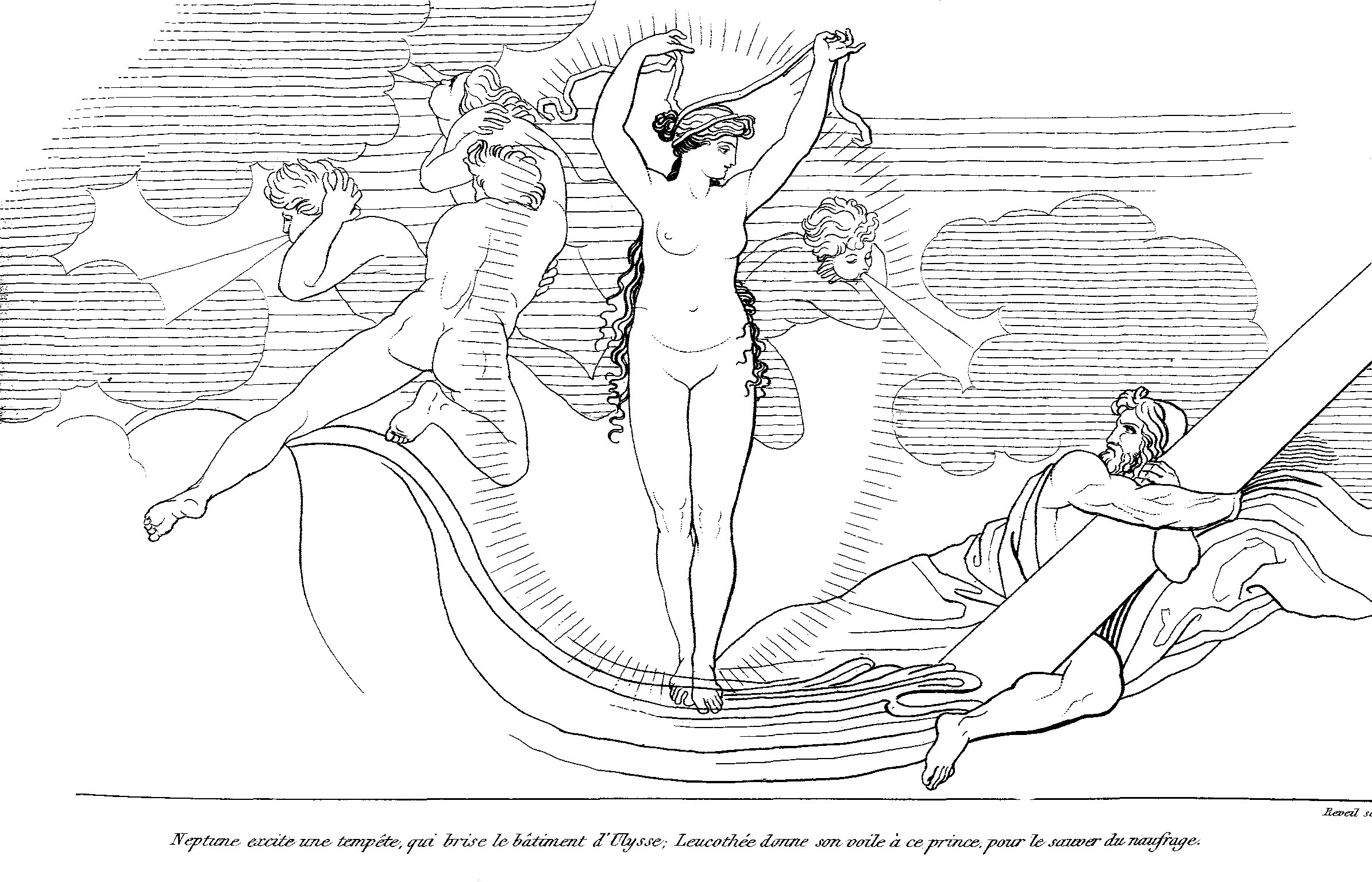
Consider again Ino-Leucothea: she appears like a bird called αἰθυίη, seemingly ‘blazing’ like a phoenix, a sea-bird we cannot identify, who emerges from a ‘lake’ (λίμνη):
αἰθυίηι ϝεϝἰκυῖα ποτὴν ἀνεδύσετο λίμνης
Looking like a petrel on the wing, she emerged from the lake … (Od.5.337)
This is odd language for an encounter on the open sea, but not for a torch-lit ritual by a pool. Beyond this ambient evocation, however, Ino the talking bird is a wondrous animation, putting Disney to shame; she leaps forth from the stage like all the creatures Homer brings to voice. She is a coquettish light in the chaos of storm and destruction, who begins by playing on Odysseus’ name, as Athena did when soliciting Zeus:
‘Luckless man, why ever does he find you—Poseidon, Ground-Shaker—
So violently Odious, that he plants so many evils for you?
But it seems he will not destroy you, for all his eagerness. (5.339-41)
She means to charm a man to take off his clothes:
‘No, you’d better do the following, and I don’t think you’re short of common sense:
Take off these clothes, leave the raft to the winds to carry—
Let it go! But swim with your arms and feel out a return home
From the land of the Phaeacians, where it is your disbursement to escape. (5.342-5)
“You’re not stupid!’ ‘Let it go!’ Ah, don’t we just. Finally she gives instruction for the rite. An audience familiar with rituals would have expected some sort of rules, but surely would not have known exactly what to expect:
‘There now, this veil, stretch it under your sternum—
It’s immortal! No fear to suffer anything at all, or to die.
But the moment you touch hands on the dry land,
Loosen it off you and throw it back into the drunken deep
Far away from the dry; but yourself, turn with your back to it.’ (5.346-50)
In Homer, it is the dramatic realisation of this figure that counts. Yes Ino’s backstory, however her painful transformation into the White Goddess is told, is there, it haunts the text, but it only serves to add watts to the electricity of her manifest presence. Homer is the table-setter, the bedmaker, and the pimp for these epiphanies: narrative, dramatic, musical, and finally poetic.
Yes Odysseus is like a dying god who comes back to life, yes he is to become the theoxenic god in beggar’s clothes. ‘Lord I am not worthy to have you enter under my roof.’ But Odysseus is not Dionysus, for all that these two, the dying god and the theoxenic stranger-in-disguise, are Dionysian archetypes. This is not that. It does not often get remarked on, but consider that Odysseus is sober. He is the guy who hordes fortified wine so he can ply it on his enemies and get the better of them. That is not the spirit of Dionysus. He is the sort of duplicitous speaker whom Achilles, in the Iliad, hates worse than the gates of hell. The sin Jesus seems uniquely to have highlighted is what we call ‘hypocrisy’. But ὑποκριτής, ‘responder’, had become the regular word for ‘actor’. When Jesus calls someone ‘hypocrite!’ he is calling them ‘actor!’ Jesus was not sober, he consecrates the wine, but he also is not Dionysus. The Athenian stage remembers Odysseus precisely as a conniving sober liar, an arch villain. Except for being bearded, he anticipates the machiavel of the Renaissance stage, the cunning pragmatist and adviser to the prince, the commander’s henchman and trusty fixer. Perhaps the biggest joke of the whole Odyssey is this idea that Odysseus could be any sort of hero. Perhaps this was Homer’s original gag! To make Odysseus a hero. (You can imagine the writer’s room banter: ‘Focus on Penelope and the boy, let him long for shitty Ithaca, he’ll be the murderous liar with a heart of gold!’) If so, Homer’s done too well, like Mel Brooks’ ‘Springtime for Hitler’; the joke was lost on Plato and the ancients, as well as all the moderns on their journeys.
A new observation into Homer’s music perhaps argues for the genuineness of his heroisation of Odysseus. There is a moment in the Iliad when Odysseus has finally had enough of servility to the unworthiness of Agamemnon. When, for the latest time, the warlord counsels escape, an ignominious pushing off of the ships by night forever abandoning the expedition to Troy, Odysseus bursts out:
σίγα, μή τίς τ’ ἄλλος Ἀχαιῶν τοῦτον ἀκούσηι
μῦθον, ὃν οὔ κεν ἀνήρ γε διὰ στόμα πάμπαν ἄγοιτο,
ὅς τις ἐπίσταιτο ἧισι φρεσὶν ἄρτια βάζειν
σκηπτοῦχος τ’ εἴη, καί ϝοἱ πειθοίατο λαϝοί
τοσσοίδ’ ὅσσοισιν σὺ μετ’ Ἀργείοισι ϝἀνάσσεις.
Shut up! Lest any other of the Achaeans hear this
Disclosure, which no man would let out his mouth at all—
Anyone who’d know in his mind’s vessels to speak what suits,
And be the sceptre-bearer, and the one whom armies obey—
So many as are the Argives among whom you’re the Lord. (Il.XIV.90-4)
The accentuation of the first line of the speech is highly unusual. Note in particular the sequence of three straight, long, acutely accented syllables, three long syllables of sharply rising pitch (μή τίς τ’ ἄλλος). There are actually five long beats in a row to begin the line, all with changing pitch. Such a sequence bluntly suspends the tripping dactylic rhythm, long-short-short. Perhaps there is a staircase effect to a high pitch peak. The line is musically as well as emotionally an emphatic outburst. This moment of defiance against authority, counter to Odysseus’ character elsewhere, evidently made a big impression on the composer of the Odyssey and its hero Odysseus. The striking accentual pattern, from beginning to mid-line, recurs several times in key speeches of Odysseus, twice in the episode with Polyphemus, including at the beginning of the fateful speech where he announces his true name to the Cyclops, and also at the moment his identity is almost revealed when the nurse Eurycleia discovers his scar and drops his leg into the wash basin. In the latter case, the words as well as the distinctive accentual pattern are resounded verbatim. Most strikingly the pattern appears when Odysseus is disguised as an old beggar, back in Ithaca, and tells a lying story about how he once bivouacked with Odysseus; he quotes Odysseus as uttering almost exactly the same hushed outburst he had used against Agamemnon. In effect, this is the disguised Odysseus trying to sound like Odysseus, among people who knew him! This is a man known for hissing ‘shut up!’, perhaps also reaching for the throat to strangle speech, as he does with the old nurse Eurycleia. But the pitch patterns by themselves, even when the words bearing them are different, are identifying. Hence Homer’s craft is pointedly at work in creating a distinct musical identity for Odysseus, in conversation with perhaps his most redeeming moment in the Iliad.
Odysseus is therefore no everyman being initiated into the mysteries. Neither is he Dionysiac, or a Bacchus who, like Euripides, calls out human pretensions to self awareness and to constructions of identity. Rather, when he crawls under vegetation on the river bank on Scheria, escaped from the drunken sea, he begins precisely to establish an identity and earn his name; perhaps also to begin correcting long standing impressions of who he is. This is Homer’s art forging an human identity through the music of hexameter rhythm, and placing its articulation in the mouth of the man himself. He even sings his own signature tune, and when in disguise, does impressions of himself. The achievement is such that the epic work itself can only be named by the man’s proper name: Ὀδύσσεια. It can be seen as a watershed in the development of the western mind and psychology, on a par with the Cartesian meditation; the articulation of an human individual in the face of various enticements to oblivion, in religion, drink, and ecstasy, or promises to the initiate of immortality. The only immortality we actually know is the immortality of song, the very best examples of which are Homer’s poems. The success of Homer’s work upon Odysseus’ name has been such, that whosoever now undergoes life’s journey looks back on it as an odyssey, and participates in this way in the mystery of man, through the man of many turns.
Homer’s art oversees its own mysteries, its own transformations, like the twin bushes on Scheria’s shore,
Planted from the same root: one of wild stock, one of olive.
These neither the strength of the winds got through, when they blew wet,
Nor did ever the blazing sun strike them with its rays,
Nor did the thunderstorm use to penetrate right the way through; for tight indeed
To one another did they grow, intertwined in a give-and-take: under these, Odysseus
Entered. Right away he gathered himself a bed with his own hands,
Nice and broad; for there was a fall of leaves, pointlessly large,
Enough to protect two or maybe three grown men
In the wintry season, even if it was ever so bitter.
When he saw this, he rejoiced! The Endurer, radiant Odysseus,
And right in the middle he lay himself down and heaped on him the fall of leaves. (5.477-87)
The sublimity of this poetry ushers in a new birth under the sun, or rather, one protected from its radiation. This hero is born in the dark. There is no speech, no storm, no histrionic drama this time, no god except the one always watching, or the one who reads out loud while you read silently. The Greek words intertwine into a nest for an human egg. At the very same time, it is dry leaves to fire a corpse. For a critic, words fail. The poetic moment speaks itself. We can never know what it was like to participate in the mysteries, but we can know what it is to be initiated into the mysteries of Homer’s poetry. It is not like anything. The Odyssey’s similes never cut straight:
ὡς δ’ ὅτε τις δαλὸν σποδιῆι ἐνέκρυψε μελαίνηι
ἀγροῦ ἐπ’ ἐσχατιῆς, ὧι μὴ πάρα γείτονες ἄλλοι,
σπέρμα πυρὸς σώιζων, ἵνα μή ποθεν ἄλλοθεν αὔηι,
ὣς Ὀδυσεὺς φύλλοισι καλύψατο · τῶι δ’ ἄρ’ Ἀθήνη
ὕπνον ἐπ’ ὄμμασι χεῦ’, ἵνα μιν παύσειε τάχιστα
δυσπονέος καμάτοιο, φίλα βλέφαρ’ ἀμφικαλύψας.
As when a fellow hides a firebrand in the black ash,
At the farthest farm, who has no other neighbours by,
Saving the seed of fire, that he need not get a light from who knows where—
So Odysseus hid himself in leaves: and on him did Athena
Shed sleep upon the eyes, that he might the soonest rest
From his hard labour and exhaustion, once she’d covered those dear eyelids round. (5.488-93)
Here again is another stick, this time a δαλός, a dying firebrand. The rhapsode’s staff is a metaphysical thing; its existence is only metaphorical, it has no existence for the composer except as metaphor. For the audience, it is not a metaphor at all; it is a firebrand being laid, gently and carefully, into imaginary ash upon the ground. As such it can become a metaphor for something else—Odysseus’ life?—and also the vehicle for a simile. The seed of fire (σπέρμα πυρός, sperma pyros), unlike the actually wielded staff, is the archetype of metaphors in our literary realm, the realm of words and language. It embodies antitheses. The sign or σῆμα of Odysseus’ identity—or, without equivocation, its symbolic tomb—is to be something more complex than what Elpenor’s oar intends.5 At certain moments like this, all the elements of Homer’s presentation nest within, or mount upon, one another, like stacked accents. Odysseus is the seed of fire, burying himself in a pyre of flammable leaves. The whole vegetative cycle of growth, the ‘nature’ of the moly, the nexus of Demeter, Persephone, and Dionysus, is all immanent in the balance of this little phrase, sperma pyros: from seed to tree to leaf and intoxicate flower, to naked intertwined branches, fallen leaves and purging forest fire. ‘So Odysseus hid himself in leaves …’ Athena, the final syncresis, comes in from nowhere, and everywhere, to cover the dead or dormant seed, along with its Odyssean eyes.
In Euripides’ Bacchae, Teiresias was already an old man when Dionysus visited Thebes and captivated its women. He and Cadmus himself trot themselves out in the latest Bacchic kit, shaking their arses. Pretty funny. But he is not otherwise a player in the Dionysiac saga or apotheosis. In other stories about Teiresias, we find out that he is the one person who has truly been both a man and a woman (but not at the same time). Could that be of interest to Homer? Possibly, I reckon. But Teiresias is someone who has lived through many ages, even before he became Cadmus’ old and blind advisor. He is like Merlin. I think that’s who he is, in point of fact, for Homer and for the Odyssey.
So does it matter that Teiresias is a Theban? After all the fuss, no, not really. I would focus on that golden sceptre, which recalls—reechoes—the sceptre of Chryses, Apollo’s supplicating priest, from the beginning of the Iliad. Teiresias, also, is meant to speak his prophecy with the authority of Apollo. So what does Apollo’s surrogate, this Merlin, have to say to Odysseus in hell?
I recommend Olga Levaniouk’s ‘The Waters of the Underworld and Ino in the Odyssey’, available here, for a stimulating thesis and references to the literature.
Levaniouk, 5-6.